Why Portfolio Management Matters More Than Stock Picking
Selecting a handful of stocks or funds isn’t the same thing as constructing an investment portfolio that is strong. Investment is about finding an appropriate mixture of assets that work in concert to achieve clear financial goals. If you don’t possess the necessary time nor knowledge to manage this kind of process, they may prefer to invest in PMS. Professionally managed services ensure that investments aren’t made randomly, but are supported by strategy, research, and constant monitoring.
Portfolio Management Services are designed to provide structure and discipline to the investment process. Companies like Anand Rathi Portfolio Management Services adhere to a specific process to manage wealth with care and in a responsible manner. Prior to invest in PMS it is crucial to know how this organized method actually functions.
What Is Portfolio Management in Simple Terms
Portfolio management involves the organized management of investments, such as the debt instruments, equities and various other market securities. A qualified portfolio manager researches markets, chooses the most appropriate investment options, and reviews their portfolios frequently. The aim is to balance the risk and returns while making sure that the investor’s goals remain at the forefront.
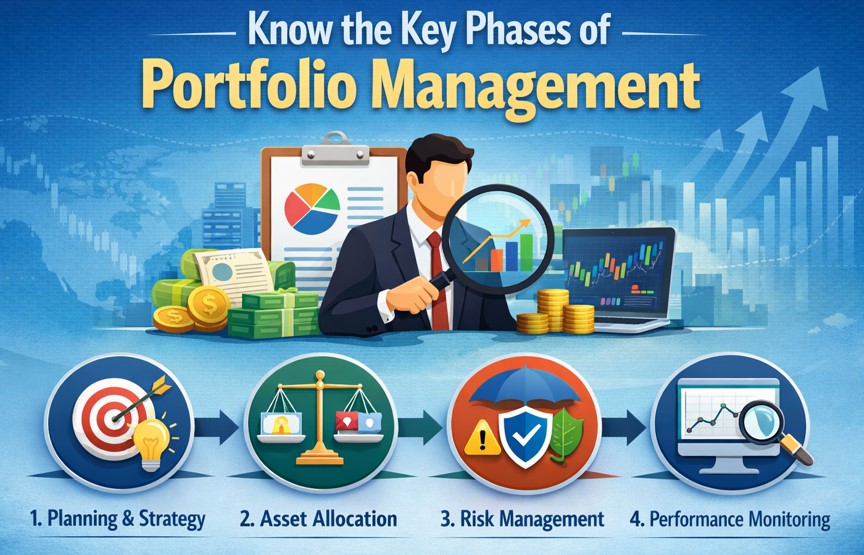
It’s similar to taking care of the garden. Seeds are carefully selected and planted in the correct spot, and inspected regularly to ensure that the growth is healthy. Similar to that investment requires management, planning and prompt adjustments. This is when the various stages of portfolio management are crucial.
Phase One: Security Analysis
The initial phase of managing portfolios is security analysis. In this phase the portfolio manager analyses specific securities to assess their worth and potential. This includes analysing the financial statements, performance of the company in relation to industry performance, as well as general economic conditions.
Both the fundamental and technical analyses are both possible. Fundamental analysis examines the strength of a company’s financials and its business while technical analysis focuses on the patterns of market price and trends. The goal is to find investment opportunities that are reasonable and capable of providing consistent growth over the course of time.
Phase Two: Portfolio Analysis
After identifying suitable securities after identifying suitable securities, the next step is analysing the portfolio. Instead of considering each investment individually, the manager examines the way they work together. The proper allocation of assets and diversification is assessed to ensure that the portfolio isn’t subject to risk that is not necessary.
Things like investment timeline, financial goals and tolerance to risk are taken into consideration with care. The market conditions as well as interest rate changes and global trends are also considered. This ensures that the portfolio matches the profile of the investor rather than market noise.
Phase Three: Portfolio Selection and Construction
In this phase the portfolio is built in accordance with a clearly defined plan. The portfolio manager selects an appropriate mix of assets which is in line with expected returns as well as acceptable risk levels. The main goal is to create the best equilibrium.
If someone decides the PMS investment option, this stage provides direction and clarity. Instead of a scattering of investments the portfolio is now focused on a specific goal. If the goal is the growth of capital or income generation, or long-term wealth creation the investment selection is made in line with the goals.
Phase Four: Portfolio Revision
Markets are constantly changing. Changes in the economy, corporate developments as well as global events may influence the performance of investments. Portfolio revision makes sure the adjustments take place as necessary.
Rebalancing can occur regularly or when allocations exceed a certain limit. This allows you to keep the risk level at a desired level and helps avoid over exposure to one particular asset category. Professional managers track these changes closely to ensure that the portfolio is in line with its goals.
Phase Five: Portfolio Evaluation
The last of the phases of portfolio management is the evaluation. In this stage, performance is compared against benchmarks that are relevant and risk measures. Risk adjustments to returns as well as consistency and reliability are analysed.
This stage determines if the strategy is delivering as expected results. If there are any gaps and improvements are needed, they can be made. Continuous evaluation helps ensure transparency and accountability within this management system.
Making an Informed Decision
Understanding these phases will give you a better understanding before deciding whether to make an investment in PMS. Portfolio management isn’t an instant action, but a process that requires planning, research reviewing, and the refinement. Anand Rathi Portfolio Management Services is a well-organized and research-driven method that is based on these principles. Knowing how each stage functions, investors are able to make informed choices and be assured about the direction that their investments will take.